Posts

Project Management Elevator Pitch

  If given only 90-seconds to impart a little wisdom about what you do as a project manager and why project management is important, what would you say? As a budding project manager with an interest in delivering solutions for learning, I came up with a sample elevator pitch as if I were interested in establishing a contractual relationship with a business or organization. The script is provided along with a .wav file (click  Elevator Pitch  to access) for your review. Afterward, share your thoughts. What would you change or say differently? Hello, I’m Angelica Christie. As a project management consultant, I assume contractual oversight and accountability for planning, resource allocation, progression, and monitoring of projects that help to achieve organizational goals. Being competitive in the 21 st century require organizations to maintain steady pace with changes that drive existing markets and ultimately drive the bottom line. Research shows that high-performin...

The Future of Distance Learning: Reflection of a Novice

Image
             Advancements in technology have been a driving force in changing societal perceptions and acceptance of the validity and value of learning at a distance. Evolving from the model of correspondence learning supported by postal delivery, radio and television mediums progressed the one-way-delivery of instruction was an early, but failed attempt to extend teaching. The failure is attributed to varying obstacles. The inflexibility of synchronous scheduling failed to consider time zones and, even greater, the absence of inter-relational connectivity and shared experience contributed to passive learning (Baum & McPherson, 2019). Innovations continued, fueled by desires to remove barriers to education and resources to promote learning. The discovery and construction of the World Wide Web technologies helped to enhance the acceptance of online learning as a method expanding educational access. The increased availability, utilization, and practi...

The Evolution of Distant Learning

Image
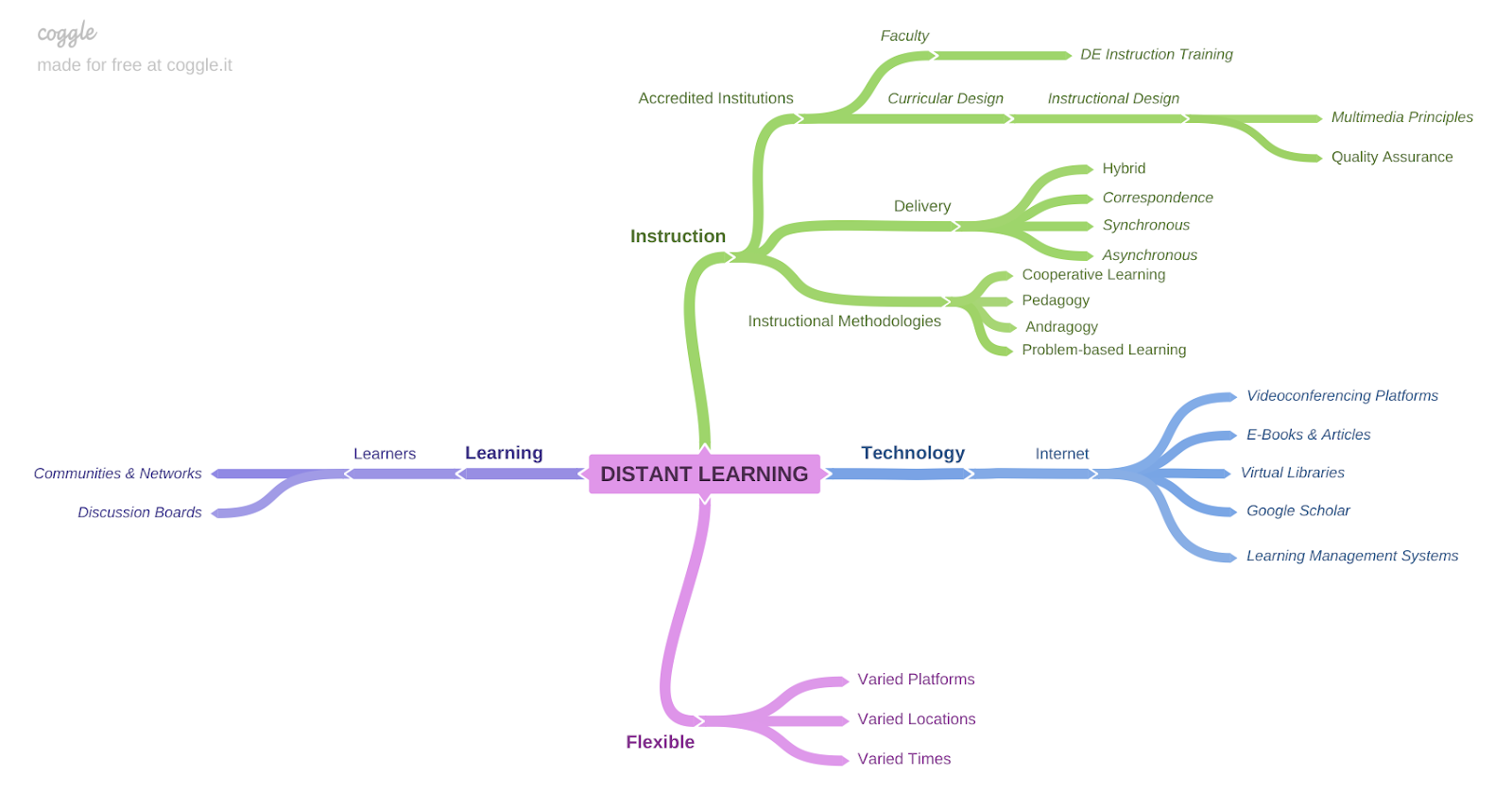
  And just like that … I’m back! Welcome to the Arrant Artificer, a space intended to explore instructional design through constructive and intellectual conversations between novice and seasoned ID professionals. Over the next several weeks, conversations will focus on the topic of distance learning – what it is, its influences, drivers of its evolution, and its role within the field of instructional design. The definition with which I enter the conversation surrounding the concept of distant learning is that it broadly encompasses the delivery of instruction for learning to occur in varying geographic spaces, at varying times, and in diverse ways that allow the learner flexibility in when, where, and how they learn. A review of resources finds that perceptions of distance often emerge from perspectives rooted in the professional domain (Simonson et al., 2019). The resources offer a more universal definition that distinguishes distant learning as the formal delivery of academic-b...

The Practicality of Learning Theories On Design and Instruction

  The introduction to and discussions surrounding learning theories, learning styles, educational technology, and motivation guided my understanding of the conceptual interconnectivity of learning and how it occurs. A reflective analysis of knowledge gained and associated social constructs broaden my perception of learning and my approach to instructional design and delivery. An abundance of research and literature are available to help to define which factors promote learning and why. From the idea of defining the member’s style for learning to the conjectures of cognition and information processing and to that which attempts to determine motivating factors, each theoretical concept seeks to label the learner. Attempting to categorize students can have unintended consequences, especially when valid, reliable, supportive assessments or processes are not included. Through reflection, I can identify aspects of various learning theories that align with my personal approach to lear...

A Tactical Reflection of Technology and Learning

Learning style refers to the method by which an individual prefers to engage with, process, and retain learned knowledge. Six weeks ago, I identified cognitive learning style as my desired approach to learning with a preference for engaging in peer-to-peer instruction. After a deep dive exploration of learning theories and personal reflection taken during that time, I considered the suggested argument of whether learning styles exist, became aware of the theory of mental intelligence, and took note of the concept of andragogy in association with adult or action learning. The exploration culminated with my acceptance of a reality where flexibility in how, why, and if learning occurs. Recognizing that prior knowledge, experience, and perception offer a foundation for learning, that independent concepts help to direct learning, and how environmental relationships influence how new concepts and knowledge are processed broadened my understanding of learning from the perspectives of both a l...

Learning Influences of Connectivity

Image
The distribution of an abundance of information through social networks to cultivate learning based upon existing knowledge, experiences, and perceptions encapsulates the basis of Siemens' theory of connectivism (Laureate Education (Producer), n.d.). Rich networks that are made available through advancing technology provide the broad social dimensions that gird the basic concepts of the learning theory. These networks affect how individuals learn professionally and socially. The following mind map visually demonstrates the networks that influence how, when, and why I learn. Technologically, existing search engines provide immediate access to valid information and data ranging from language enunciation to research. This is my go-to when I have questions relating to any subject. New information is often introduced asynchronously through social media networks, including Facebook, and Instagram, which I choose to validate through internet searches. LinkedIn networks often provide artic...
Problem Solving  Life is full of problems. The challenge lies in how we work to solve them. Formulating judgment through a process of analysis and evaluation is a cognitive skill that develops over time and through experience. Problem-solving involves the use of  encoding, retrieval, and metacognition skills.   Encoding involves the process of identifying what the problem involves and determining the optimal solution for obtaining the best resolution. In short, how one determines what the problem involves and identifying the best end result is considered the process of encoding.  Retrieval is one's ability to recall information that has been stored within long-term memory and is related to the problem at hand. Metacognition is the process of "thinking about thinking". Self-monitoring the problem-solving process to determine the level of progress and if the approach to achieving the optimal solution is effective. Problem-solving is essential to every aspect of our l...